”Growing wheat 2.0 means protecting nature”
Why choose Wheat Flour 2.0?
– The environmental reasons alone are significant. Smarter wheat cultivation supports biodiversity, reduces water pollution and sequesters carbon in the soil, says Elina Valkeinen, a contract farmer for Helsinki Mills' Wheat 2.0 and ProAgria's plant production expert.
In spring 2024, Elina got a tip from Toni Lindqvist, a farmer in the SatoKlubi group, about the Helsinki Mills Wheat 2.0 project.
– Toni noted that we already have a team ready for that. Things got off to a fast start, as we already had the basics of sustainable farming in place and preparations for the new growing season were just getting underway. After listening to a presentation by farmer Pekka Kultti, the Grain Purchasing Manager at Helsinki Mills, some of our group decided to join in," says Elina.
In the Wheat 2.0 fields of Elina and four other Finnish contract farmers, crop rotation, catch crops, extended vegetation cover, precision fertilisation and appropriate crop protection will guide their operations and yield prospects.
"I like Helsinki Mills' sustainability programme, which is tailored to Finnish, local conditions. Myllärin is familiar with Finnish farming techniques and uses common sense."
Elina Valkeinen
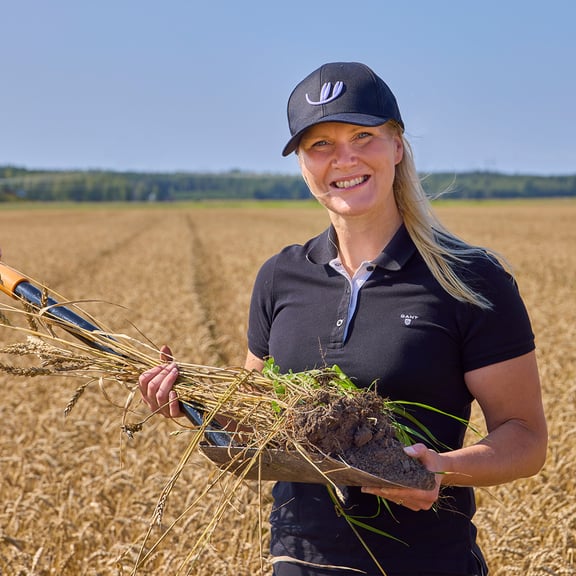
– When the soil is in good condition, it produces better harvests. Soils in good condition also store significant amounts of carbon from the atmosphere, says Elina Valkeinen, a Wheat 2.0 contract farmer and ProAgria's plant production expert.
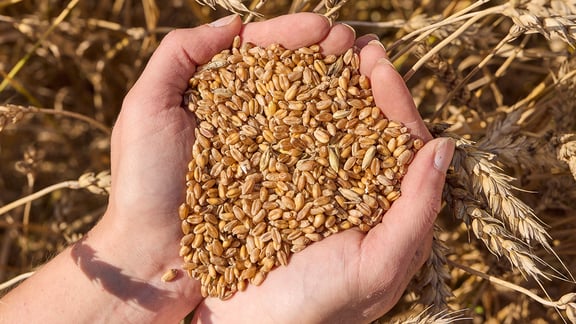
– Farming is a continuous learning process: every growing season is an opportunity to develop your own farming techniques, says Elina. – With 10 years of experience, I'm just at the beginning of my career.
”Targeted farming is environmentally friendly and economical”
Elina Valkeinen, who also studied to be a forestry engineer, currently farms 160 hectares of fields in Elimäki, in the village of Raussila, together with her husband.
On the fifth-generation family farm, Elina's father helps during busy seasons. The young master, a 6-year-old boy, is also growing up to fill the boots of a farmer.
– Ten years ago, I took a big step and assumed responsibility as the successor. When it is a profession and a business, not a hobby, you are also responsible for the finances of the farm – what remains below the line. The key factors are the soil fertility and the allocation of inputs.
– The better the soil, the better the yields, says Elina, explaining the background to regenerative farming.
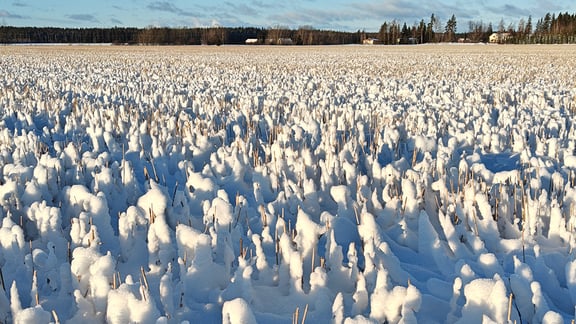
Subzero temperatures and frozen ground are beneficial for crops. Frosts reduce the vitality and abundance of plant diseases and pests in the soil, reducing the need for pesticides. Frost shapes the soil and promotes water supply of plants. Finnish winters also benefit grain storage, as cooling requires less energy than in warmer climates.
Some of the farm's wheat fields are sown over the winter, while others are lightly tilled in the autumn. In clay soil areas, spring wheat sowing requires precise timing, as it is not possible to go out into the fields too early, even though at the same time the moisture in the soil is needed for the crops.
In regenerative farming, humus content and structure are improved through measures such as diverse grass mixtures. The crop is supported by catch crops, which take up the nutrients left over from the previous season's crop and make them available for the next crop.
– We keep valuable nutrients in the field. For crop plants, we only give them what they really need – nothing extra. It's both economical and environmentally friendly, as we fertilise more precisely during the growing season. We save on fertiliser costs while reducing water pollution, says Elina.
Soil in good condition stores carbon
Because of its weaker root system, wheat is a demanding crop that cannot withstand drought in the same way as oats, for example. The short growing season is also a challenge for spring wheat farmers.
– The earlier we can sow, the better the wheat will benefit from the sun's radiant energy and the earlier it will be ready for threshing. We need to get to the threshing stage before the autumn rains, says Elina, explaining the impact of the timetable on crop prospects.
Climate change and extreme weather conditions are also clearly visible in Elimäki.
– Years are not brothers, not even relatives. We walk around the field and observe the situation all the time, so that we can time our interventions as precisely as possible and give the crop what it needs at that particular moment.
– In a rainy summer, excess fertiliser must not be allowed to leach into water bodies. On the other hand, during the dry summer of 2024, we saved the Wheat 2.0 harvest by watering the fields by sprinklers, when water was fortunately available from a river running through the fields.
In the Nordic countries, when we talk about forests as carbon sinks, it is easy to forget that the soil, the basis of our food production, is the world's second largest carbon storare, just after the oceans. Soils in good condition store carbon from the atmosphere in significant quantities.
– Targeted farming is environmentally friendly, efficient, and economical. Without compromising on yield targets, we farmers have an excellent opportunity to contribute to biodiversity, environmental protectio,n and climate change mitigation, Elina points out.
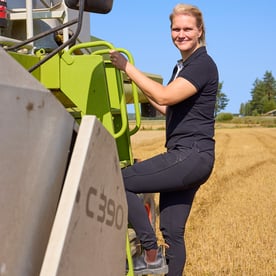
In Raussila, Elimäki, spring wheat is sown as soon as the field is ready to go, so that the Wheat 2.0 crop will be ready for threshing before the autumn rains.
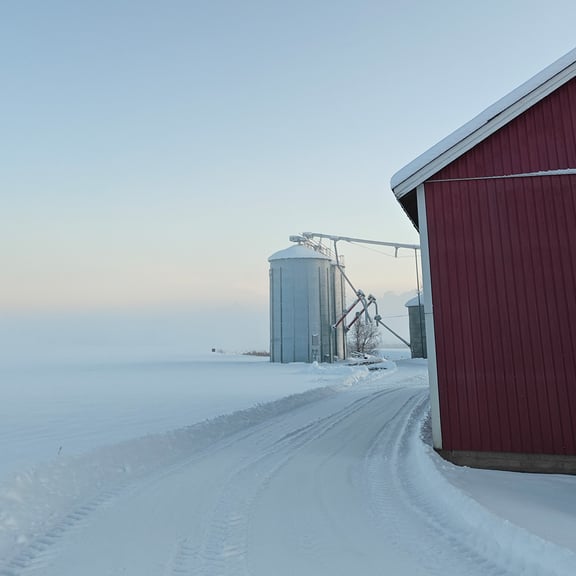
In January 2025, Elina Valkeinen's family farm is waiting to see how the winter wheat will fare over the winter. And planning for spring wheat sowings. To support crop plants and biodiversity, the plans include catch crops, flower fields, and expanded plant cover.
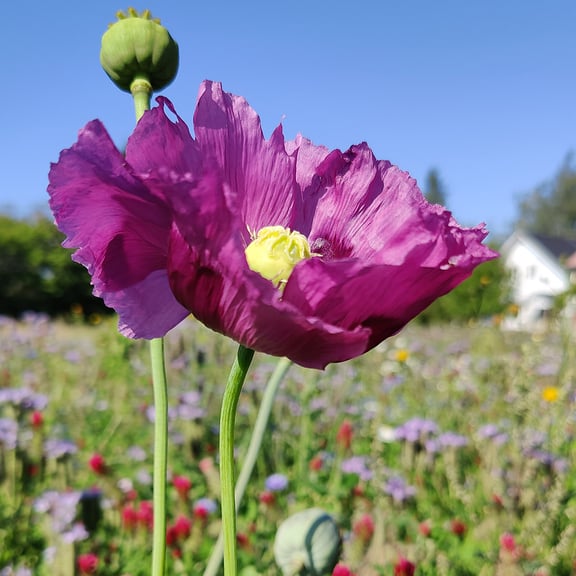
”Every growing season is an opportunity to learn and develop"
In January 2025, as in the previous ten winters, Elina's working day will be filled with her duties as a plant production expert at ProAgria. Throughout the year there is customer work and appearances related to her job, which she handles from her home office and Kouvola office, but during the short summer and busy growing season, Elina stays at her home farm in Elimäki.
– My roles support each other nicely. I can use my own experience as a farmer and be close to other farmers at the same time. We engage in deep discussions and speak openly. In groups and networks, you can always ask about hot topics. Information is shared, and there is no jealousy. Everyone wins when Finnish agriculture succeeds.
The family farm is entering a new growing season with the same curiosity and enthusiasm as a young master starting preschool. Now we wait to see how the winter wheat will fare over winter. Spring wheat, malting barley, oats, peas, winter wheat and turnip rape are planned.
– Nothing is done on the basis that it has always been done this way. Let's think carefully about what we are doing right now and why. What to aim for and how best to achieve the desired outcome. This growing season, we will further refine previous techniques and measures, further refine our response to the growing season and increase the number of catch crops.
For Elina, farming is a continuous learning process: every growing season is an opportunity to develop her own farming techniques.
– We test new things in small areas first. We are also ready to learn from our mistakes. No one is born a blacksmith, nor a farmer. Now in my forties, with only ten years of experience, I feel I am at the beginning of my career, so I am constantly learning by questioning and asking why.
A varied job with a view, working on her family farm – that is Elina's passion. Working on something for the love of the game gives you energy for the hectic summer season. It is easy to draw strength from living in the midst of an ever-changing "painting", a rural landscape.
– I believe that my strenth lies in my ability to enjoy the little moments in everyday farm life. Like dewdrops on a spider's web," says Elina, who has been looking forward to the arrival of spring and the smell of the May field ever since she was a child.

– I like Helsinki Mills' sustainability programme. Myllärin is familiar with Finnish farming techniques and uses common sense, says Elina.
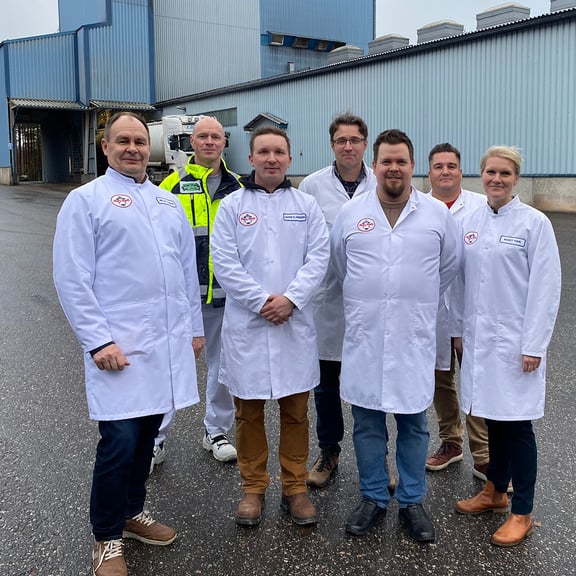
Wheat 2.0 farmers learning about wheat processing at Helsinki Mills in Järvenpää. From left to right, Kari Alasaari, Plant Manager Martti Loikkanen, Toni Lindqvist, Jussi Myyrinmaa, Mikko Peuranpää, Grain Purchasing Manager Pekka Kultti and Elina Valkeinen.
For the wheat baker from five sustainable farmers
The growing condition and biodiversity of Finnish fields are a priority when five Helsinki Mills’ contract farmers grow wheat under the sustainability programme.
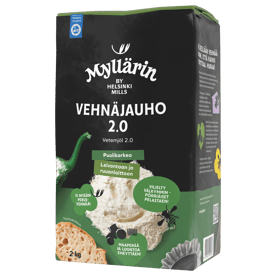
"Conventionally" grown wheat flour will be completely removed from Myllärin's range. In the future either Myllärin Wheat Flour 2.0, grown according to the company's own sustainable farming programme, or Myllärin Organic Wheat Flour, grown organically, will be available.
With sustainable farming, everyone wins: the soil, the water system, the pollinators, the farmer and, above all, the baker of wheat treats. Ground from large, high-quality grains at the Järvenpää mill, semi-coarse Myllärin Wheat Flour 2.0 is suitable for all kinds of baking and cooking.
Follow the Wheat 2.0 farmers on Instagram to get a feel for sustainable farming and information to support your purchasing decisions:
Alasaari Kari, Lapua @tuplakari
Lindqvist Toni, Myrskylä @agrilindqvist
Myyrinmaa Jussi, Nurmijärvi @jussimyyrinmaa
Peuranpää Mikko, Tuusula @peuranpaa
Valkeinen Elina, Elimäki @ellu_farms