Kari Alasaari:
"I am responsible for the oats I grow even when they reach the consumer"
– Something a little bit better. What gets done, gets done right. Actions speak and promises are kept. I'm curious about everything new, I want to be at the forefront, says Kari Alasaari, the godfather of the Helsinki Mills sustainable farming programme and an Oats and Wheat 2.0 contract farmer from Lapua.
In Härsilänkylä, Lapua, Kari Alasaari has a diverse crop farm covering over 100 hectares of land, which his family has been farming since the late 17th century. In the 2020s, spring and autumn cereals, oilseeds, legumes, and caraway are grown on fertile fields.
Kari's path to becoming a precision farming pioneer, digital farmer, farm advisor, trainer and consultant is one of passion, enthusiasm, and curiosity.
– I was wondering whether to study agriculture or engineering, which I have always been interested in. I chose Tampere University of Technology in Hervanta, graduated with a Master of Science in Technology (telecommunications) and ended up in TeliaSonera's innovation department, developing new solutions.
From 2003 onwards Kari managed both the farm and his day job, until in 2010 the home farm became his main focus. An interesting user-centred product design development project with the University of Helsinki and a manufacturer of agricultural machinery was on offer at the turning point. After this, advisory work began alongside farming, which keeps him busy even when snow covers the plains.
– Technology and agricultural machinery have always been close to my heart. Telecommunications is a familiar field, and working with companies is routine for me, and I enjoy networking. I've always liked working as a self-employed entrepreneur, says Kari.
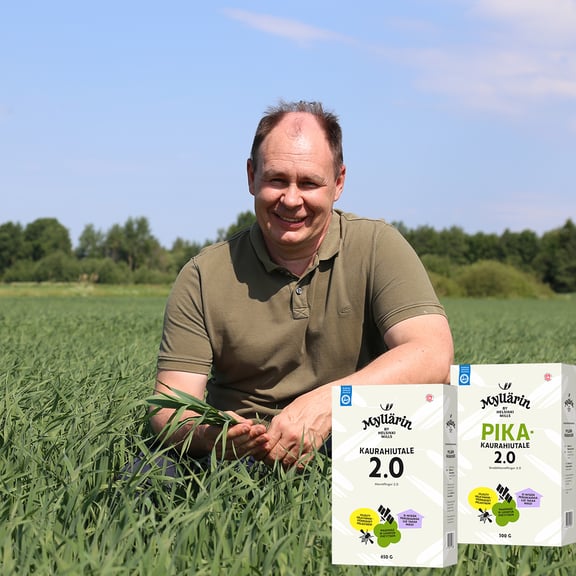
Oats 2.0 are grown under the sustainable farming programme on Alasaari and Mäki-Latvala farms in South Ostrobothnia. – I am responsible for my actions: my decisions and actions have affected this oat, but also the farm's environment, says Kari Alasaari, contract farmer and godfather of the Helsinki Mills Sustainable Farming Programme. (Photo: Agraari Oy)
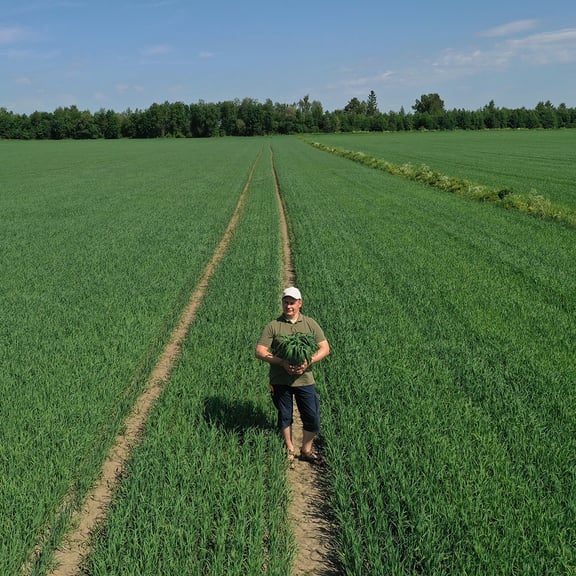
In the 2025 growing season, Oats 2.0 will take up about a quarter of the arable land on the Alasaari farm. In addition to barley, turnip rape, and spring wheat, the plan includes caraway seed and triticale. This year's autumn sowings are planned for wheat only. (Photo: Agraari Oy)
"I'm not satisfied with what I get. I want to challenge myself to do better."
In Kari Alasaari combines the roles of experimenter, developer, entrepreneur, and practical doer in an interesting way. Kari is a pioneer and trendsetter in both resource-efficient precision farming and the digitalisation of agriculture.
– Development work based on monitoring and carried out on our own fields clearly produces results. The 12th growing season is about to begin. There is data and I take advantage of it. I have been conducting experiments and testing for years, both on my own and with several companies, says Kari, who has also successfully challenged himself in several international harvest competitions.
– In the UK, grains from two oat sections will be analysed in early 2025 to know exactly which trace elements will be used in the summer 2025 precision fertilisation, Kari takes a topical example of the farm's development work.
However, technology alone will not produce a good harvest. The field must have good soil fertility, Kari stresses.
– Even though my own fields are mostly in good condition, I'm constantly thinking about how I can improve them. What does the plant need to produce a good harvest in a resource-efficient and environmentally friendly way. How soils and crops withstand extreme weather conditions. What kind of plant breeding work should be done so that we have the best possible varieties even after 10 years.
– There are many variables in agriculture that are beyond our control. But when fields have good soil fertility, for example, Oats 2.0 can better withstand hot and dry wheather and blazing sunshine without losing growth. And the field will produce the most consistent crop possible, even in challenging growing seasons.
"Some grow crops smartly. Do the job differently."
Kari has collaborated with Helsinki Mills all of 2020’s. When Grain Purchasing Manager and farmer Pekka Kultti asked Kari to be a consultant for the sustainable farming programme, Kari said yes. After all, the farmer was at the heart of the programme.
– The starting point was that whatever is brought into the programme must make sense to the farmer. No greenwashing, but something that benefits us farmers.
The piloting of Oats 2.0 has already shown that the right measures are in place to produce the most consistent harvest possible, while respecting the farmer, the farm, and nature. Indeed, the Helsinki Mills sustainable farming programme was launched in 2022 at a perfect time. Resilience and perseverance are needed to cope with a changing environment and market conditions.
As demand increased in 2024, Helsinki Mills asked Kari Alasaari to become an Oats 2.0 farmer. In the same year, an agreement was also reached on Wheat 2.0. Wheat 2.0 flour, which became available in stores in February 2025, is made from wheat grown by Kari and four other Finnish sustainable farmers. In the future, Myllärin will only offer 2.0 and organic wheat flour.
– I like the fact that the partner, a 90-year-old Finnish family business, has a face. It's great when you can work with a partner who shares your values. We are in sync, Kari sums up.
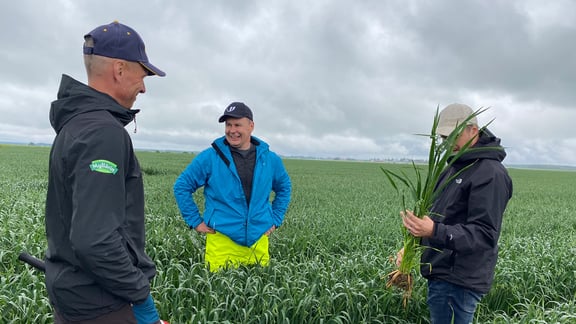
Kari Alasaari (centre) wants to challenge himself to always do better.
– I think about what the plant needs to produce a good harvest in a resource-efficient and environmentally friendly way.
He also shares his lessons with the other sustainability farmers of Helsinki Mills, who visited Kari's fields in the summer of 2024. In the photo with Kari, admiring the beautiful oat roots, Mikko Hölsö (left) and Jussi-Pekka Juvela.
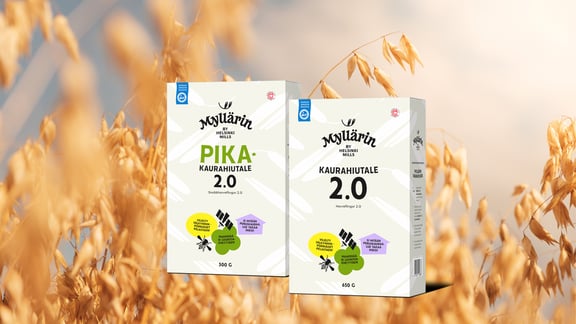
Myllärin Pika Kaurahiutale 2.0 and Kaurahiutale 2.0 are both Produce of Finland, smartly grown oats from Lapua and Ilmajoki.
"Everything that can be done. But only what is necessary."
In 2024, Oat 2.0 was cultivated on 30 hectares in Härsilänkylä, Lapua. The average yield was 6,000 kg per hectare.
–The harvest season got off to a great start: sowing was on time, we got good crops, we fertilised well and we didn't have to bother buzzy bugs with aphid control methods. The crops grew green all summer, the fields absorbed the heaviest rains, and the result was high quality oats. In summary, however, oats do not like hot weather: the heat capped the peak yields, Kari sums up a relatively challenging harvest season.
In the 2025 growing season, about a quarter of the arable area will be used for Oats 2.0. In addition to barley, turnip rape and spring wheat, the crop plan includes caraway seed, winter wheat and triticale, as well as land improvement plants and other catch crops. Autumn sowings for autumn 2025 are planned for wheat only.
– Oats 2.0 fits in well with the overall picture. We don't even sow oats after oats, says Kari, who swears by crop rotation.
– For example, after turnip rape, the field is left unworked over the winter. Spring tillage is carried out on the plots just before sowing the oats to prevent nutrients from leaching into water bodies and to maintain spring moisture in the field.
Timely tillage, crop rotation based on flowering plants and precision fertilisation play a big role in the sustainable farming programme that aims to minimise the environmental burden. Kari hopes that the “smartly grown" will be understood by Finnish consumers. Hopefully, this will also correct the perception that nutrient loads in spring-flooded, turbid rivers are automatically caused by intensive agriculture.
– There are differences in cultivation methods. I want to stand out in a positive way. This oat comes from my farm; it is grown by me. I am responsible for my actions: my decisions and actions have affected this oat, but also the environment of the farm. In my opinion, Oats 2.0 is one of the best ways to highlight and raise awareness among Finns about smarter, more sustainable farming.
– Of course, here in South Ostrobothnia, a great environmental feat was already done in the 1970s, when flood banks were built under duress in order to make good arable land available for cultivation. At that time, no one understood what significance those embankments would have 50 years later. Spring floods still do not reach our fields. The water in the canals is clear and there is less run-off into the waterways, says Kari Alasaari with satisfaction.
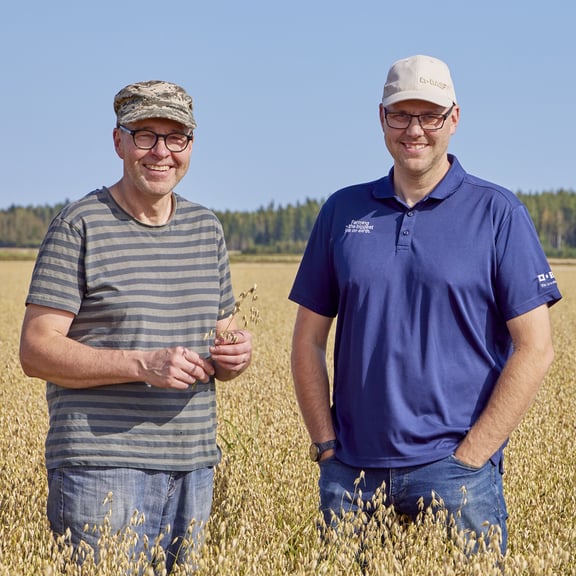
Veikko and Mikko Mäki-Latvala.
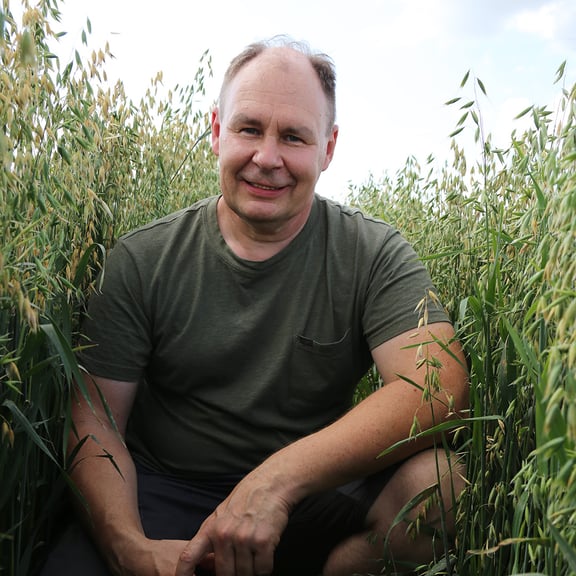
Kari Alasaari.
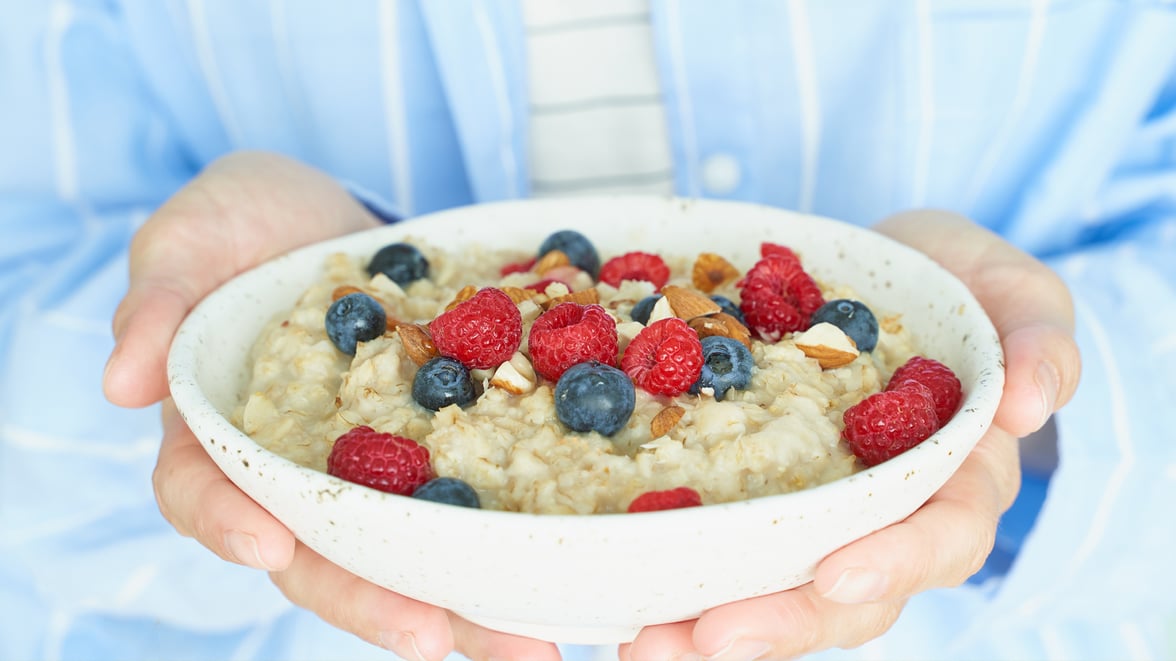
Oats 2.0: Very good, smartly grown from South Ostrobothnia
Myllärin Oats 2.0 products carry the Produce of Finland label. The geographical location of the oats can be specified as South Ostrobothnia - Lapua, Alasaari farm and Ilmajoki, Mäki-Latvala farm. For farmers and Helsinki Mills, origin is more than just a country, a continent, and locality. As important as where the oats are grown is how they are grown. Myllärin's Oats 2.0 is a smartly grown grain. You can taste it in the Oats 2.0 products.
We Finns are interested in the origin of our food. According to the European Food Safety Authority (EFSA) Special Eurobarometer 97.2*, the three most important factors influencing Finns' food purchasing decisions are cost, origin, and nutrient content. In 2022, both the origin and the nutritional content of food were 10 percentage points more important factors for Finns than for Europeans.
According to the Suomi Syö (in English, “Finland Eats”) 2024 survey**, more than 40% of Finns have changed their food choices for environmental reasons. 40% want more information to make greener choices when buying food - up to 57% of women under 35.
*EU food safety, EFSA Special Eurobarometer 97.2.,10/2022; A total of 26,509 interviews, of which 1,011 in Finland.
** Suomi Syö, Taloustutkimus 8/2024; An online survey of over 6,000 Finns aged 16-79.