A journey into history: When the Puhk brothers set up a mill in Helsinki
The earliest references to the Puhk family’s mill in Estonia date back as far as the 1550s. However, modern business is generally considered to have begun with Jaak Puhk, who was born in the Viljandi region of Estonia in 1861 and who, with his wife Anna, had one daughter and five sons.
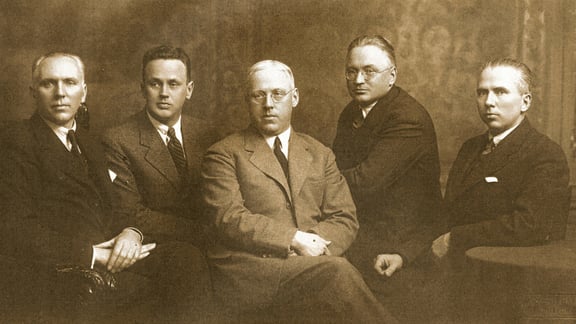
Of the five Puhk brothers, Eduard (right) moved to Helsinki with his family to run the newly established mill. When it was completed, the Sörnäinen mill was the only large mill in Helsinki where wheat and rye were ground for wholesalers.
Jaak, who had set up general stores, a match factory, and a sawmill, brought his son into the family business, which was named J. Puhk ja Pojad. After Estonia gained independence, the brothers had a flour mill built in Tallinn, which was the largest and most modern in the city. The growing company expanded its chain of mills to Tartu, Narva and Pärnu.
In the 1930s, Finland relied largely on imported wheat. The Puhk brothers decided to capitalise on the market situation and open another mill in Helsinki.
A suitable spot was found from Helsinki, on the Sörnäinen waterfront. The incorporation meeting was held on 8 October 1934, and by the following autumn the premises had been converted for use as a mill.
When it was completed, the mill was the city’s first and only large mill. Grain was purchased both domestically and from abroad, and the daily milling volume ran into tens of thousands of kilograms. According to the mill’s advert, the milling machinery purchased from Bühler AG operated “as cleanly and precisely as a Swiss watch.”
The second eldest of the brothers, Eduard Puhk, moved to Finland with his family and took over the running of the company.
In the autumn of 1939, the Second World War broke out. The Soviet Union demanded territorial concessions and military bases from the Baltic states and Finland. The other Puhks also moved to Finland and settled temporarily at the Hotel Torni.
However, once the Winter War had broken out, the situation in Estonia appeared to have calmed down, and the family returned home at the turn of the year. It was a tragic decision.
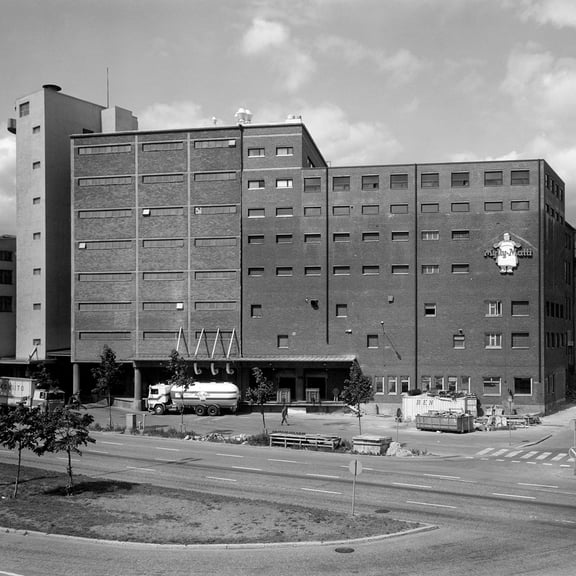
Helsinki Mills on Sörnäisten Rantatie in 1983. (Photo: Johnny Korkman, Helsinki City Museum)
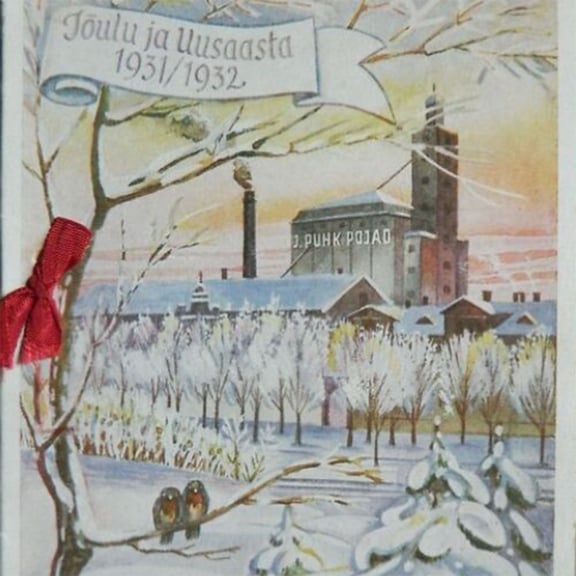
In the 1920s, J. Puhk & Pojad had commissioned the construction of the largest mill in the Baltic Sea region at the Port of Tallinn. Shortly after sending this Christmas card in 1932, the brothers decided to set up a mill on the other side of the Gulf of Finland, in Helsinki.
The Soviet Union occupied the whole of the Baltic states in June 1940, and all the Puhks’ possessions were confiscated. By that year’s autumn, all the Puhk brothers, with the exception of Eduard, had been arrested and sent to prison in the Soviet Union. They were never to be seen again.
Eduard Puhk, devastated by grief, died in Helsinki in 1943. His right-hand man, Gustav Gardberg, took over the management of Helsinki Mills. During his tenure, an oat mill and the crispbread factory Matin Leipä Oy were built in Sörnäinen. Jüri Puhk, the son of Eduard Puhk, took over the management of Matin Leipä Oy in 1956. He became managing director of Helsinki Mills in 1964.
Find out about the history of Helsinki Mills